Speak with an expert
Have questions about our products? Get in touch with one of our industry experts.
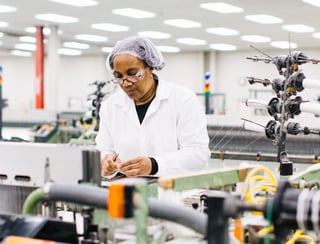
Our environmental and operational performance cannot be separated from the people behind our processes. From plant operators and engineers to corporate teams and product developers, TenCate Protective Fabrics depends on a skilled and engaged workforce to operate responsibly.
We recognize that sustainable manufacturing requires safe working conditions, fair employment practices, and a respectful workplace culture.
This responsibility extends across our value chain, including suppliers (see Supply Chain Due Diligence) and partners, but begins with our own workforce.
Health, safety, and well-being are integrated into daily operations and governance structures (see Health and Safety). Our approach combines regulatory compliance, structured human resource policies, and ongoing workforce development.
Employees are our most valued assets. We aim to provide safe, respectful, and professional working environments across all locations.
We believe a diverse workforce strengthens our organization. Different backgrounds, experiences, and perspectives contribute to better decision-making and innovation.
We provide equal opportunities to all employees and applicants, regardless of origin, age, gender, religion, sexual orientation, gender identity, disability, or other personal characteristics.
We do not tolerate discrimination, harassment, or inappropriate behavior. Every employee is expected to contribute to maintaining a respectful workplace environment.
At TenCate Protective Fabrics, social programs provide employees with structured opportunities to engage with their communities while supporting internal communication.
The Engager Network Group, with 28 members globally, supports two-way communication between employees and the organization and helps coordinate community and environmental activities across regions. Members model core behaviors such as communication, reliability, and teamwork, reinforcing a consistent workplace culture.
At the site level, additional initiatives, including employee support programs, provide practical resources for local teams. Together, these efforts connect employee engagement with community involvement across our global operations.
Training and education at TenCate Protective Fabrics focus on building core capabilities and supporting employee development across regions.
We provide a combination of targeted programs and digital learning platforms to support leadership development, technical skills, and day-to-day job requirements. These tools offer flexible, accessible learning aligned with individual roles and organizational needs.
Employees are also encouraged to pursue cross-training opportunities across teams, supporting skill development and operational flexibility throughout TenCate Protective Fabrics.
All employees at TenCate Protective Fabrics receive annual performance evaluations through a standardized global process. This approach helps ensure clear expectations and supports ongoing professional development across our regions.
The process is supported by Trakstar, a centralized platform where employees and managers set goals, track progress, and document performance reviews. These evaluations provide a framework for discussing performance, skill development, and potential career pathways.
Individual development plans are a key component of this process. By linking performance evaluations with development planning, we support internal mobility and help employees build the skills needed to take on new roles within TenCate Protective Fabrics’ global operations.
VSME code B3-29: Total Energy Consumption
| Total Energy Consumpion (MwH)* | |||||
| 2024 | 2025 | ||||
| Total | Renewable | Non- renewable |
Total | ||
| EU - Dyeing and Finishing plant - Nijverdal | Electricity* | 5,159 | 4.987 | 4.987 | |
| Fuels (bio gas***, and natural gas**) | 55,242 | 98 | 56,202 |
56,300 |
|
| US - Dyeing and Finishing plant - Molena | Electricity* | 6,832 | 603 |
5,431 |
6,034 |
| Natural gas** | 21,577 | 21,232 | 21,232 | ||
| US - Weaving plant - Zebulon | Electricity* | 7,749 | 762 | 6,860 |
7,622 |
| Natural gas** | 1,644 | 1,695 |
1,695 | ||
| US - Yarn plant - Senoia | Electricity* | 14,448 | 1,528 |
13,751 | 15,279 |
| Natural gas** | |||||
| US - Nonwoven plant - Senoia | Electricity* | 521 | 55 |
493 | 548 |
| Natural gas** | |||||
| US - Headquarters - Union City | Electricity* | 1,044 | 102 |
914 | 1.016 |
| Natural gas** | 248 | 230 | 230 | ||
| Global totals (MwH) | 114,464 | 8,135 | 106,808 | 114,943 | |
*Renewable energy – In Nijverdal, RECs from ACT Commodities B.V. cover electricity consumption, certifying renewable EU sources.
Electricity for US operations is supplied by Georgia Power; the 2024 energy mix includes approximately 10% renewable energy (solar, hydro, and wind)."
**Natural gas data originally reported in m³ and CFF has been converted to MWh using Lower Heating Value (LHV) conversion factors, in accordance with DEFRA UK guidance.
***In-house biogas production from sludge water treatment, avoiding sludge waste disposal
The CSRD is a key regulation in sustainability reporting. Recently, a number of...
Read article
In professional workwear and safety fabrics, the shift toward eco-friendly...
Read article
The Corporate Sustainability Reporting Directive (CSRD) focuses on supporting...
Read article
6501 Mall Blvd Union City
Union City, GA 30291
United States of America
+1 (770)969-1000
© 2024 TenCate Protective Fabrics